These stories first ran on our website in our early years. They’re the cases that showed us why rescue groups need help with routine costs: the worming, the skin treatment, the x-rays and the weeks of good food that turn a neglected Boxer into a family dog.
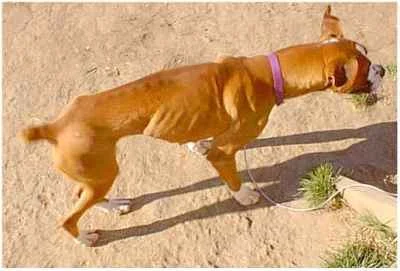
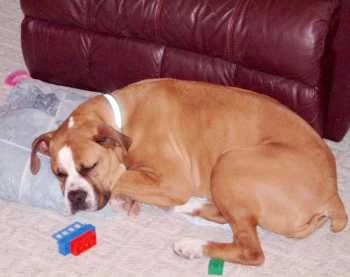
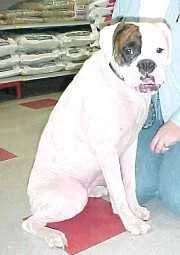
Tulip, arrivingTulip, at home
North Missouri Boxer Rescue
Tulip
Months before she reached rescue, Tulip was treated for a mange so severe it left her almost hairless. Her owners didn’t pay the bill. Later another vet kept her for more than ten days trying to control seizures that lasted for hours, and found her nearly emaciated and full of parasites. Back home, barely able to walk or see, she was found seizing in a neighbor’s yard and handed to animal control.
Cathi Newlin of North Missouri Boxer Rescue took her on, even though the vet questioned whether Tulip would recover at all. “She could barely stand,” Cathi said. Her muzzle was grey and she weighed under 30 pounds. After two weeks of seizure treatment she was strong enough to be spayed, and she “talked to me the whole way home.”
In foster care her hair grew back, the swelling in her feet went down and she gained weight. The seizures stopped; they had most likely been caused by starvation. As she recovered it became clear she was only about eleven months old, not several years. The grey left her face and her black mask came back.
Under 30 lbarriving in foster care
Almost 70 lbgoing home in January
She went to her forever home with a silky coat and her own pillows. Her family said she was a dream.
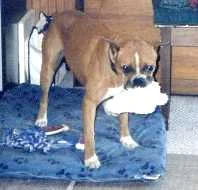
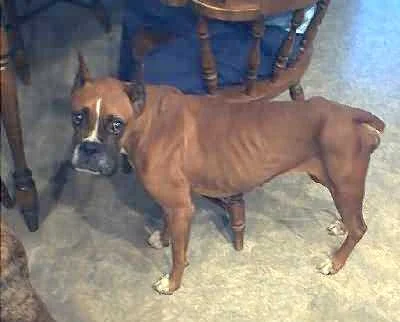
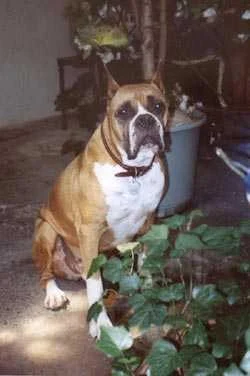
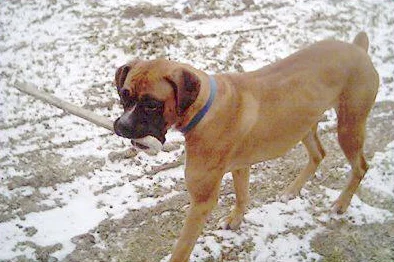
Little Bo, beforeLittle Bo, with a toy
Rockin’ “P” Rescue
Little Bo
Little Bo spent years chained to a doghouse. Another Boxer owner finally persuaded his owners to give him up, but he’d never been socialized and couldn’t live with other male dogs, so Rockin’ “P” Rescue stepped in.
At five years old he had heartworm, whipworms, hookworms and a severe case of ear mites. Clearing the worms and feeding him came first; after two weeks he’d gained six pounds and was ready for heartworm treatment. At first he was afraid to be inside a house and didn’t know how to play with toys. In foster care he learned basic obedience, though “stay” was hard because he was so excited by the attention.
36 lbentering foster care
52 lbready for adoption
About $340vet bill, with a discount
Finding a home for a five-year-old who still looked rough and needed to be an only dog took time. He went to live with a young man who wanted a loyal companion, and the two clicked right away.
Abby
Scranton Boxer Rescue
Abby
Election Day 2001 was the luckiest day of Abby’s life. Voters walking to their polling place passed the spot where the eight-year-old had been tied outside for years. Neighbors had given up trying to help, but the voters complained to the animal shelter, and shelter officials took her.
Abby had flea anemia and what her vet called the worst whipworm and hookworm infection she’d seen in 18 years of practice. She weighed under 35 pounds.
Over $1,000cost of her treatment
Dawn Karam of Scranton Boxer Rescue says Abby never stopped wagging her tail through all of it, as though she knew life was changing. She went to a loving family, healthier than she had probably ever been.
Peyton
Greater Ohio Boxer Rescue
Peyton
A rescue volunteer spotted nine-month-old Peyton at the SPCA. She was bloody and her skin was falling off from demodectic mange, with a bacterial infection on top that made every movement painful. She was dehydrated, and a tumor on her front leg had to be removed.
Killing the mites that cause mange can take months of treatment, patience and money. Peyton’s worked: she gained thirteen pounds and was adopted by an attentive, loving family.
$380her veterinary bill
Rachel Osborn says mange is a routine problem with rescue Boxers. Peyton is one more example of the everyday needs rescue groups face.
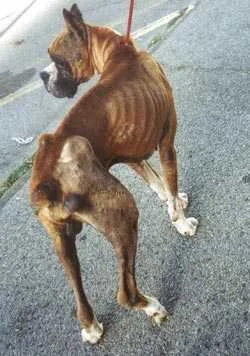
Streets, when foundStreets, after
Boxer Rescue of Los Angeles
Streets
On a hot summer day, a passer-by called Boxer Rescue of Los Angeles about an injured Boxer lying on a scalding sidewalk. Volunteers found a four-year-old covered in mange and emaciated. X-rays showed a broken leg, and he had a liver problem too.
Even after surgery on the break, there was little hope he’d use the leg, so an amputation was scheduled. Nobody wanted to give up, so it was put off. To protect the foot he was dragging, volunteers made him booties out of golf club covers. Through months of tests, treatment and rehabilitation, Streets stayed friendly to everyone.
He gained weight, started using the leg, and the booties came off. He went to a home where he got plenty of love.
In the year before this story ran, Boxer Rescue of Los Angeles placed 720 Boxers. Cases like Streets’ raise the average cost of rescue, and adoption fees don’t cover the extras.
Kali, running again
Toby’s Gift
Kali
Kali wasn’t a rescue dog. She was a young family’s Boxer who cut both legs to the bone on sheet metal just after they’d moved, with a new baby and a well to replace. Toby’s Gift paid her veterinary clinic toward a four-hour surgery and her aftercare, and she went on to run and play as only a Boxer can.